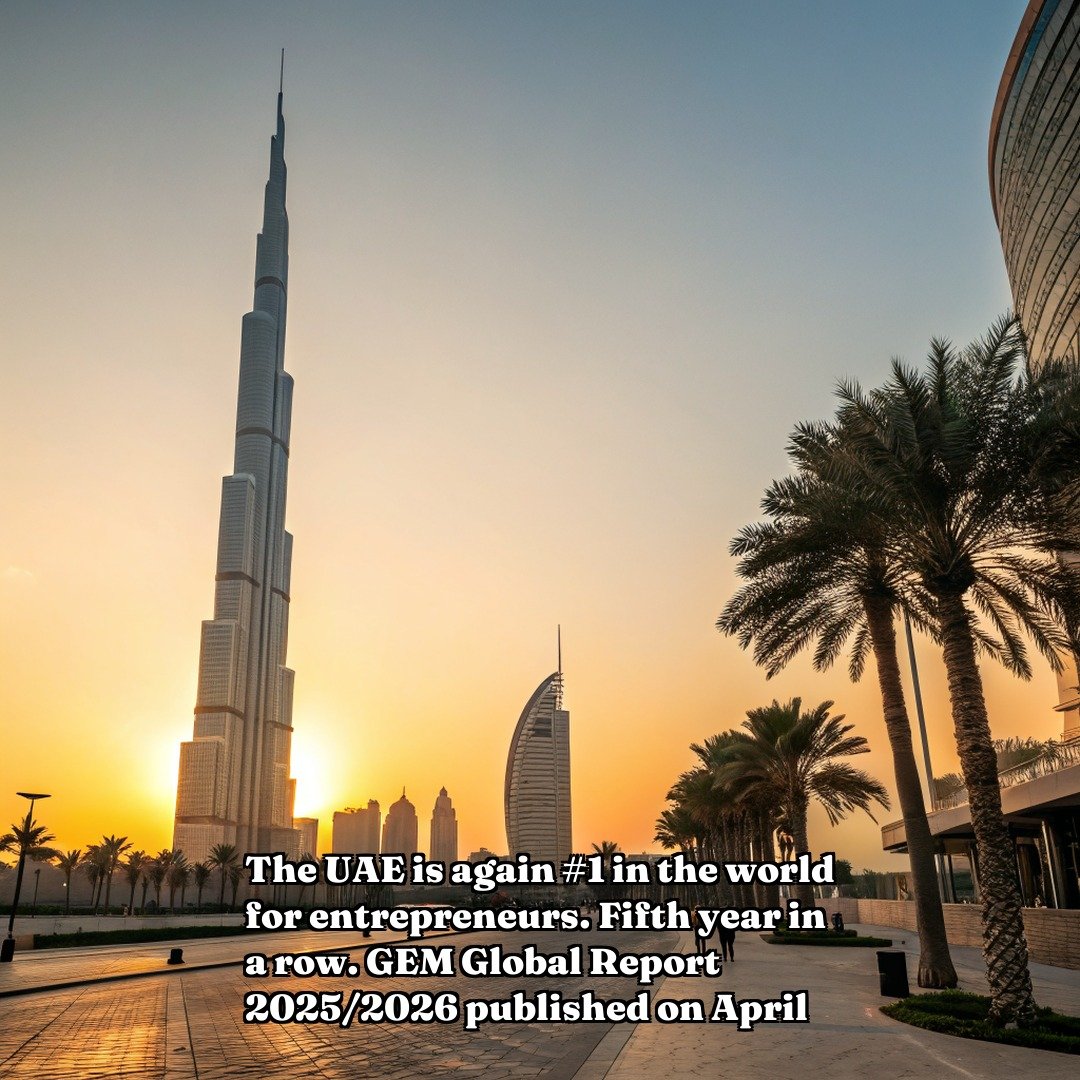
The Global Entrepreneurship Monitor (GEM) has published its annual 2025/2026 report, and the UAE once again ranks first in the world on the National Entrepreneurship Context Index (NECI) — an index measuring the quality of the entrepreneurial environment. Fifth year in a row. Score 7.0 — ahead of the US, Singapore, Saudi Arabia, India. The UAE topped the ranking among high-income countries across eight key indicators: physical infrastructure, government support, taxation and bureaucracy, entrepreneurial education, R&D transfer, ease of market entry, regulatory burden, and government programs.
I look at this report not as a tourist postcard, but as a critical leading indicator for the real estate market. Let me explain why.
What NECI Is and Why It Works
NECI is not a marketing ranking. It’s an academic index that GEM has been compiling since 2018 through a panel of 36+ national experts in each country, condensed into 13 framework conditions. From startup financing to infrastructure quality. Only four economies in the world met all 13 conditions in 2025–2026: the UAE, India, Lithuania, and Saudi Arabia. The UAE is the only Gulf country that has consistently held first place.
In practical terms, this means: opening a company in the UAE takes 1–3 days, getting a license — a week, hiring a foreign employee — a month, accessing international markets via direct air traffic — the same time as a meeting within a single city. From my own experience, I know how rare this combination is in today’s world. Most jurisdictions sacrifice one thing for another.
The Connection to Real Estate Is Direct, but Not Obvious
In standard real estate market analysis, people like to look at GDP, migration, and interest rates. These metrics are important, but they reflect the past. NECI is a leading indicator. It answers the question: will this country, in 2–3 years, have new companies, new offices, new employees with salaries and spending capacity?
When a jurisdiction consistently holds #1 for five years in a row, entrepreneurial capital starts flowing into it. Not tourists. Not employees of multinational corporations (although them too). But specifically founders — people who came to launch a business. This is a structurally different class of residents.
A founder buys real estate not as an investment, but as an operational base. They need an office — rented or owned. They need housing close to the office, because early-stage startups demand 12-hour days. After two or three years, when the company is profitable, the founder buys a second apartment for Airbnb. After five years, if the business has grown — a villa for the family. This trajectory is well known from Singapore, Tel Aviv, London. It’s now unfolding in Dubai and Abu Dhabi.
Numbers on the 2030 Horizon
The UAE Ministry of Economy has set a goal: 1 million entrepreneurs by 2030. That’s +600k on top of the current 400k. Each of these people is a potential real estate buyer or tenant.
If even 30% of these 600k new founders purchase housing in the UAE over five years — that’s 180,000 transactions, pure additional demand on top of migration. At current average ticket sizes in Dubai and the northern emirates — that’s an investment flow of roughly 180–250 billion AED.
Of course, not everyone will buy. But even 10% means 60k transactions that aren’t currently in the market’s financial model.
Where This Demand Concentrates
Business districts. Business Bay, DIFC, Dubai South, Sheikh Zayed Road — this is where founders rent offices and buy housing within walking distance. Entry prices in DIFC have grown 38% in two years. This is not a bubble — it’s structural demand.
Free Zone clusters. Dubai Multi Commodities Centre (DMCC), Dubai Internet City, Sharjah Research Technology and Innovation Park (SRTIP), Abu Dhabi Hub71, RAKEZ. Each cluster generates a flow of founders looking for housing within a 5–7 km radius.
Studios and 1BRs in branded developments. A founder in the first 2 years doesn’t buy a 2BR — they buy a studio or 1BR in a managed complex. This is the standard product for a new entrepreneur-resident. Demand for this format consistently outpaces supply.
AI-related clusters. A separate story — the GEM report indicates that the UAE is among six countries in the world where entrepreneurs recognize the critical importance of AI on a three-year horizon. Dubai AI Campus opens in 2026, Hub71+ AI in Abu Dhabi is already operational. This creates demand for housing specifically in these locations.
What to Avoid
Tourist viewpoints without business infrastructure. Marina Beachfront, Palm Tip, Bluewaters — beautiful, but a founder doesn’t live there. They live closer to work. These zones are good for a second unit for Airbnb, not for the first.
Off-plan on 5+ year horizons in districts without planned commercial components. If a project doesn’t have offices, retail, and schools planned — founders won’t go there.
What I Recommend
If your focus is capital growth on a 5-year horizon, invest in real estate within a 7 km radius of three clusters: DIFC, Dubai South (startups and AI), and Hub71 in Abu Dhabi. Minimum 1BR, optimum 2BR in a branded development.
If your focus is rental cashflow, focus on serviced apartments in managed buildings. A founder rents for 6–12 months and moves on — high turnover, but also high tickets.
Most importantly — don’t miss the next GEM report in 2027. If the UAE holds #1 for a sixth year in a row, it will definitively cement structural demand. Entry prices in the zones mentioned will rise 15–25%.
Sources: GEM 2025/2026 Global Report | GEM Consortium — UAE #1 Worldwide Again | Khaleej Times | Gulf News
FAQ
What is NECI?
The National Entrepreneurship Context Index — an academic index measuring the quality of the entrepreneurial environment, calculated by the GEM Consortium based on a panel of 36+ experts in each country and 13 framework conditions. Scale 1–10.
What does a score of 7 mean for the UAE?
It’s the level of “sufficient for sustained growth of entrepreneurship” under GEM methodology. Only 4 economies in the world reached this level in 2025–2026: UAE, India, Lithuania, Saudi Arabia.
How does this ranking affect real estate prices?
The direct mechanism — an inflow of founders with purchasing power. On a 5-year horizon, the country’s target is +600k entrepreneurs. Even a conservative 10% of housing buyers = 60k additional transactions.
Which districts will receive the main inflow?
DIFC, Business Bay, Dubai South, Sheikh Zayed Road in Dubai. Hub71, Saadiyat in Abu Dhabi. RAKEZ clusters in Ras Al Khaimah.
How should a long-term investor factor this in?
Build a structural demand premium of 1.5–2.5% on top of the current YoY price growth into your financial model within the perimeter of the business clusters.