
What the Metro Doesn’t Tell You: How Dubai Treats Detail
I look at this differently: the most telling thing about Dubai’s transport system isn’t the driverless trains, it’s the fact that nobody who rides it thinks twice about a train having no driver. That’s the actual signal. When infrastructure works well enough to become invisible, boring, unremarkable, that’s not an accident. It’s a design decision made a decade in advance and defended through a lot of unglamorous maintenance since.
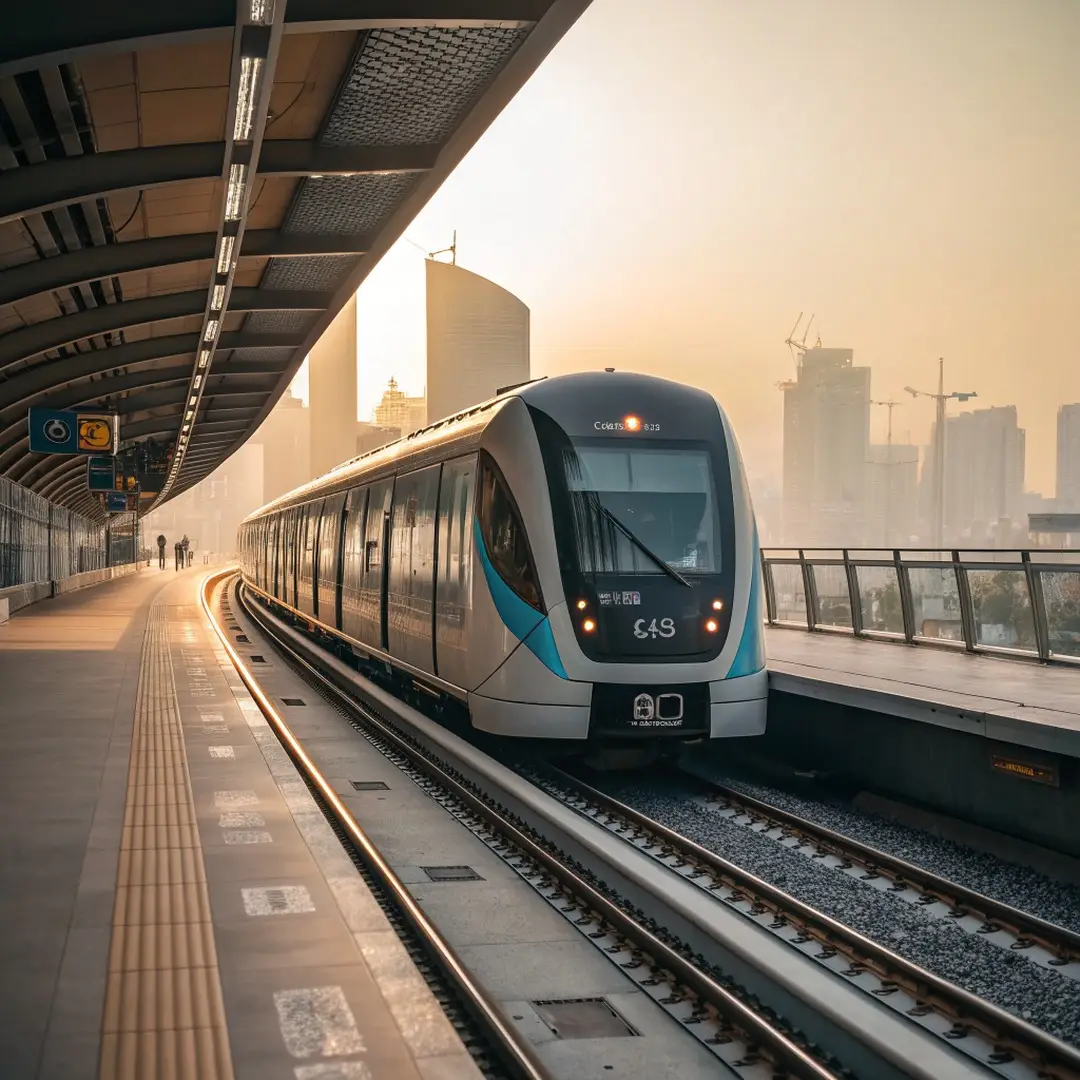
I ride the Metro more than I probably should admit for someone who spends his days talking about villas and off-plan towers. Partly habit, partly because sitting in Sheikh Zayed Road traffic is a worse use of an afternoon than almost anything else I could be doing. And every time, the same small detail catches my attention: there is no one driving the train.
The Dubai Metro has run without drivers since it opened in 2009, which made it, at the time, one of the longest fully automated metro networks anywhere. No cab, no operator, no one to blame when it’s two minutes late. Trains run on a fixed schedule controlled from a central operations center, with sensors handling the things a human driver would otherwise judge: speed, spacing, doors, obstacles. What caught my attention here is how little anyone talks about this. In most cities, a driverless train would be a headline. In Dubai it is simply Tuesday.
That tells you something about how this city approaches infrastructure. Automation here isn’t a showcase feature bolted on for a press release. It gets built into the base layer, then left alone to be reliable. I see the same pattern in how new communities get wired for smart access or how off-plan towers spec their building management systems from day one rather than retrofitting later. The visible flash, the Burj, the fountains, the artificial islands, gets the coverage. The invisible discipline underneath it is the part that actually makes a city function at this density.
The card in your pocket tells a similar story, in a quieter way. Nol is Dubai’s unified fare card, and it works across Metro, tram, bus, and water taxi, which sounds unremarkable until you have used a transit system where the bus card and the train card are two different pieces of plastic that don’t talk to each other. Nol removes that friction entirely. One tap, any mode, no thinking required. Having walked more than a few relocating clients through their first month here, I’ve noticed the Nol card is usually the single fastest thing that makes Dubai feel manageable to someone who arrived a week earlier still jet-lagged and slightly overwhelmed. It is a small, almost boring piece of infrastructure, and that is exactly the point: the best systems disappear into the background of daily life.
Ride the Metro past rush hour and you’ll notice something else: pink seats, a pink floor marking, a separate section near the front of certain cars. These are the women and children’s carriages, reserved by rule, not by suggestion, and enforced with fines for men who sit there. It’s a policy choice that reflects the wider social fabric here rather than an afterthought stapled onto the transport plan. Whether or not it matches the transit norms of wherever you’re reading this from, it is consistent with how Dubai designs public space generally: explicit rules, clearly marked, applied evenly. Ambiguity is treated as a flaw to be engineered out, not a feature to preserve.
Put the three pieces together, the automation, the unified card, the carriage rules, and a pattern emerges that has very little to do with trains specifically. This is a city that treats infrastructure the way most places treat their flagship architecture: as something worth getting exactly right, because everyone will interact with it every single day and small friction compounds fast at scale. A driver’s habits or a bad morning don’t show up as a two-minute delay multiplied across a million daily riders. A missing carriage rule doesn’t stay a footnote; it becomes the thing regular riders complain about for a decade. Building the extra discipline in early is, in a strange way, the cheaper option.
What I find more useful than the trivia itself is the transferable habit: the parts of a system that get zero attention are usually the parts that took the most work to get right, and they’re often the most honest indicator of how a place actually operates day to day, well beyond whatever the skyline is doing.
Frequently Asked Questions
Does the Dubai Metro really have no driver?
Yes. It has operated as a fully automated, driverless network since it opened in 2009, with train movement, spacing, and doors managed by a central control system rather than an onboard operator.
What is the Nol card and do I need one to use the Metro?
Nol is Dubai’s unified transit card, valid across Metro, tram, bus, and water taxi. You do need one (or the RTA app equivalent) to ride; single paper tickets exist but are far less convenient for regular use.
Are the women and children’s carriages mandatory?
Yes. They are marked in pink near the front of the train, and men who sit in them without a valid reason can be fined. It’s an enforced rule, not an informal courtesy.
Is the Dubai Metro worth using instead of driving?
For anyone commuting along the Sheikh Zayed Road corridor or between Downtown, Marina, and Business Bay, yes, it is often faster and considerably less stressful than driving during peak hours.
Does the Metro connect to the airport?
Yes, both the Red Line and Green Line serve Dubai International Airport terminals, and the system also links to Al Maktoum International via connecting bus routes.
I’ve stopped thinking of the Metro as a novelty and started reading it as a kind of report card on how the city sets its priorities. The trains don’t announce that logic out loud. They just keep running, on time, without anyone at the front.