
Dubai Smart City in 2026: What Autonomous Taxis and AI Government Services Already Do
I look at this differently: the number of icons on the home screen of its app matters less than whether a stranger who knows nobody in town and speaks no Arabic can pay a fine, renew a document, and get a ride home without talking to a single human. Dubai already clears that bar on more counters than most capitals I have visited, and it did it quietly, in pieces, over a decade, rather than in one flashy launch.
The city’s approach has never been a single unveiling. It is closer to a long series of small substitutions: a counter becomes a kiosk, a queue becomes a scan, a driver becomes a monitor sitting with hands off the wheel. Most residents notice the change only when they try to do something the old way and find the old way gone.
Where autonomy already carries passengers
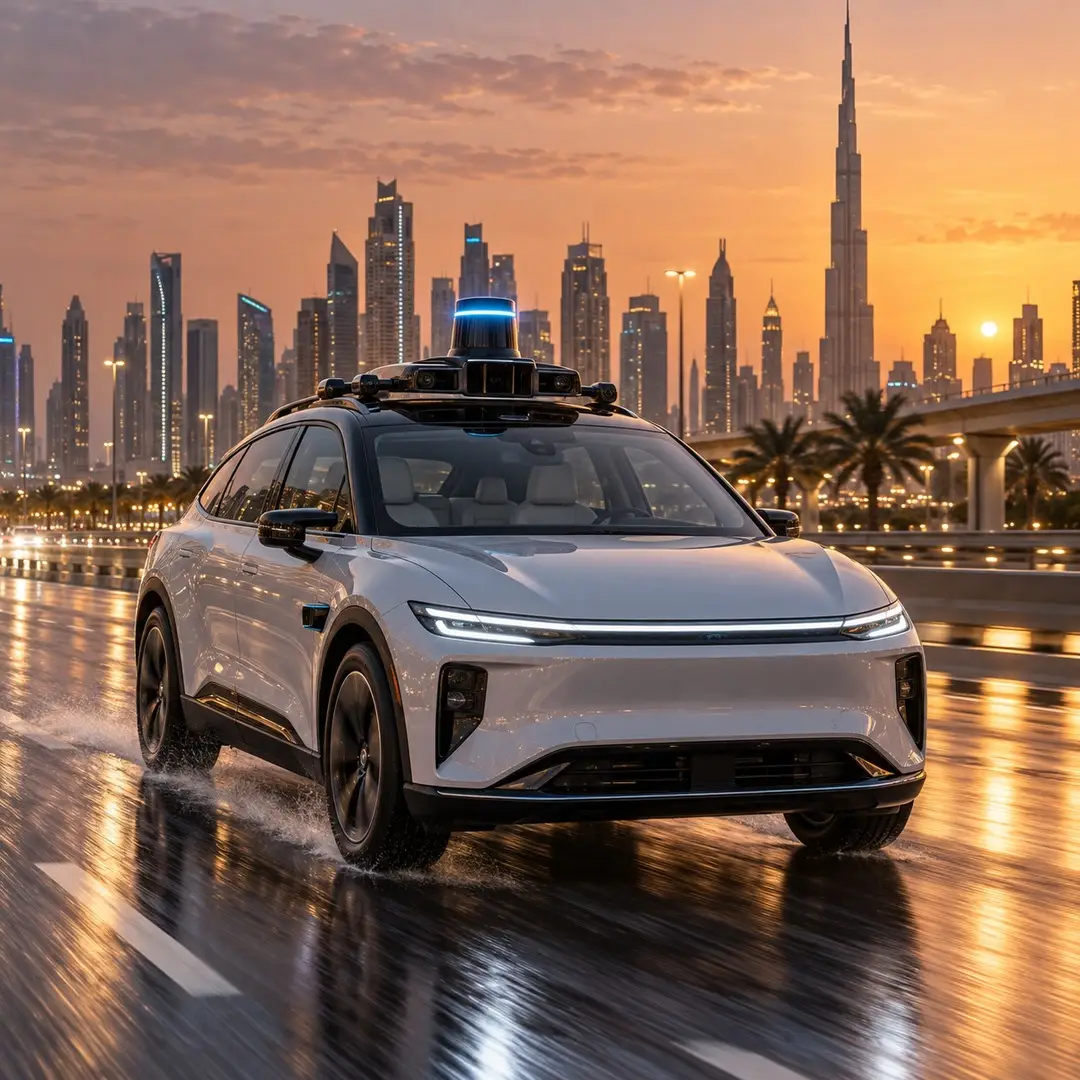
Dubai’s Roads and Transport Authority set a public target years ago for a meaningful share of all trips in the emirate to run without a human driver by the end of the decade, and it backed that target with actual road trials rather than concept videos. Partnerships with autonomous-vehicle developers, including the Chinese firm WeRide, have put self-driving vehicles on mapped routes in the city, each with a safety monitor on board who can take control but rarely needs to.
I have watched one of these vehicles sit at a light on Sheikh Zayed Road with its monitor reading something on a tablet, hands resting in their lap, not on the wheel. Nobody around the car reacted. That is the actual signal, not the vehicle itself: the novelty has already worn off for the people who share the road with it. A self-driving car that draws a crowd is a demo. A self-driving car nobody looks at twice is infrastructure.
The rollout has stayed narrow and mapped rather than citywide, which is a sensible pace for something operating around pedestrians, cyclists, and the usual mix of aggressive lane changes on a Gulf highway. The strategy has always been staged corridors first, not blanket coverage, and that caution is easy to miss if you only read the press releases about the destination.
Government by kiosk, not by counter
The more disruptive story is not the cars, it is the paperwork. Dubai Police runs unmanned smart stations where a resident can file an incident report, pay a fine, or get a case reference number from a kiosk, no officer required for the routine cases. I filed a minor report at one of these stations myself and the entire interaction, from walking in to getting a printed reference, took less time than parking usually does at a shopping mall nearby.
Immigration works on the same logic at the airport. Smart gates read a face or an iris and clear a traveler in seconds for categories that once meant a manned booth and a stamp. UAE Pass, the federal digital identity layer, now sits behind dozens of services across police, courts, utilities, and licensing, so a single verified login replaces a stack of physical documents that used to travel between departments by hand.
I renewed a vehicle-related document from my phone last year in under two minutes, sitting in traffic, and the only reason I noticed the moment at all was that I remembered doing the same task in a government building a few years earlier, with a number ticket and a wait. Nobody announces these upgrades with fanfare. They just quietly retire the old process and leave the building open for the people who still prefer walking in.
The detail that says more than the strategy document
Here is the detail that tells you more about how this city treats the future than any policy paper does. The same week I renewed that document from a traffic jam, I stood next to one of the mapped autonomous test vehicles waiting for its safety monitor to finish checking something on a screen before the car pulled off. Two systems, built by the same government, moving at completely different speeds. One process had already gone fully unattended. The other still kept a trained human within arm’s reach of the wheel, on purpose.
That gap is not a failure of coordination. It is closer to a policy: automate the paperwork aggressively because a wrong form field is cheap to fix, and automate movement carefully because a wrong decision at speed is not. A city that understood the future only as a marketing story would want both to look equally finished. Dubai seems comfortable letting them look uneven, because they are.
Frequently asked questions
Are Dubai’s robotaxis available to the general public right now?
Trials operate on specific mapped routes with a safety monitor on board rather than as an open, driverless service across the city. Access has expanded gradually rather than all at once, and that gradual pattern looks intentional rather than delayed.
What is UAE Pass and why does it matter for this topic?
It is the federal digital identity system that verifies a resident’s identity once and then lets that single login work across police, courts, licensing, and utility services. It is the piece of infrastructure that makes kiosk-based government possible, because a kiosk cannot recognize you the way a clerk who has seen your file before can.
Do the smart police stations replace physical police stations entirely?
No. They handle routine transactions like filing certain reports or paying fines without staff present, while more serious matters still route to staffed stations. The kiosks exist to absorb volume, not to remove the option of a human interaction.
Why does the government move faster on digital services than on autonomous vehicles?
The cost of an error differs by orders of magnitude. A digital form that needs correcting is a minor inconvenience. A driving decision that goes wrong at speed involves other people’s safety, so regulators keep a human monitor in the loop even while the underlying technology matures.
Is this smart city push mainly aimed at tourists or at residents?
The infrastructure is built for residents first. Tourists benefit from smart gates and a handful of visible showcase routes, but the deeper investment sits in systems residents touch weekly: fines, renewals, reports, licenses. That is where the actual load lives.
The city has not finished this transition, and it is not trying to convince anyone that it has. What it has done is remove enough friction from enough small, recurring tasks that the remaining gaps, a monitor still holding a wheel, a kiosk still limited to routine cases, stop looking like shortcomings and start looking like a sequence still being worked through in order.